|
THE PUG CLUB OF NSW INC |
|
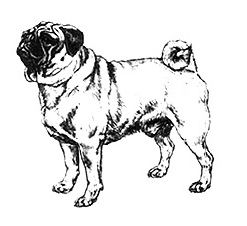
The Pug Breed Standard
Pug
Great charm, dignity and intelligence.
Even tempered, happy and lively disposition.
Head relatively large, round, not apple-headed, with no indentation of skull. Muzzle relatively short, blunt, square, not upfaced. Nose fairly large with well open nostrils. Wrinkles on forehead clearly defined
Dark, not too large, round in shape, soft and solicitous in expression, very lustrous, and when excited, full of fire. Never protruding, exaggerated or showing white. Free from obvious eye problems.
Slightly undershot. Wry mouth, teeth or tongue showing all highly undesirable. Wide lower jaw with incisors almost in a straight line.
Slightly arched to resemble a crest, strong, thick with enough length to carry head proudly.
Legs very strong, straight, of moderate length, and well under body. Shoulders well sloped.
Short and cobby, wide in chest. Ribs well sprung and carried well back. Topline level neither roached nor dipping.
Legs very strong, of moderate length, with good turn of stifle, well under body, straight and parallel when viewed from rear.
Neither so long as the foot of the hare, nor so round as that of the cat; well-split-up toes; the nails black.
High set, curled tightly over hip. Double curl highly desirable.
Viewed from in front should rise and fall with legs well under shoulder, feet keeping directly to front, not turning in nor out. From behind action just as true. Using forelegs strongly putting them well forward with hindlegs moving freely and using stifles well. A slight unexaggerated roll of hindquarters typifies gait.
Fine, smooth, soft, short and glossy, neither harsh, off-standing or woolly.
Silver, apricot, fawn or black. Each clearly defined, to make contrast complete between colour, trace (black line extending from occiput to tail) and mask. Markings clearly defined. Muzzle or mask, ears, moles on
Ideal weight: 6.3-8.1 kg (14-18 lbs).
Any departure from the foregoing points should be considered a fault and the seriousness with which the fault should be regarded should be in exact proportion to its degree and its effect upon the health and welfare of the dog.
Colleen Kirgan-Khoury Deb Cummings Kathy Gill Alaina Walters |